
🧭 Thinking about user intent routing
When you make a request to an AI assistant, it gets "routed" somewhere — a search engine, an app, a web service, or handled internally by the AI itself. How that routing decision is made, who benefits from it, and whose priorities are being quietly sorted in the background are questions worth continuing to pay attention to.
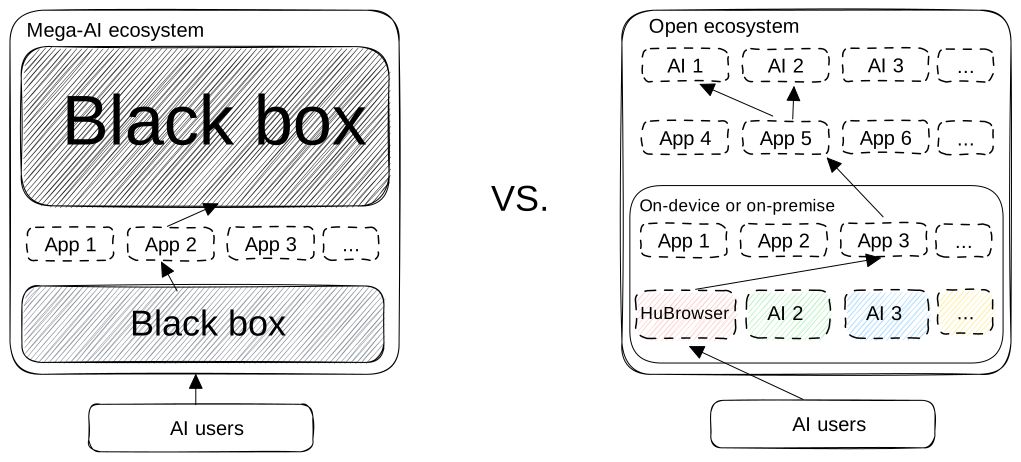
The diagram above sketches two possible directions for how AI handles user intent. One is end-to-end black-box processing by a few large service providers. The other is a solution where users configure different services themselves. The reality will likely be a mix of both.
How business models shape routing
Not all tools route intent the same way. The business model behind a product creates ongoing, often invisible pressure on its routing decisions — not necessarily malicious, but hard to entirely avoid.
Free tools typically monetize through advertising and commercial partnerships. This means:
- Search results may be influenced by paid placement or platform agreements
- Recommended content may prioritize merchants and services with commercial relationships with the tool
- Traffic gets directed toward partners, sometimes overtly, sometimes not
Paid tools face different incentives. When users pay directly, there's more motivation to optimize for user outcomes rather than advertiser outcomes. But this doesn't mean paid products are entirely neutral — they too can favor their own ecosystem, push certain integrations, or simplify in ways that sacrifice transparency for a cleaner interface.
Tradeoffs between two directions
Which direction becomes dominant likely won't be decided by any single design choice — it'll follow the funding and incentives behind whichever tools gain the most users.
Closed ecosystem
One direction leads toward a small number of dominant AI platforms that handle everything internally. You send a command, get a result, and the routing logic stays invisible. Apps gradually become plugins to a central system.
The appeal:
- A smoother user experience: end-to-end optimization by the same system reduces friction and inconsistency across services
- Lower cognitive load: users don't need to think about "which tool is right for which task" — the system decides for you
- Faster error recovery: unified context makes conversations more coherent, with more natural correction when things go wrong
- High-quality vertical integration: hardware, models, and system services deeply coordinated to deliver experiences that are hard to replicate in open approaches
Costs worth considering:
- High adaptation costs for developers trying to integrate with multiple competing platforms, leading to ecosystem fragmentation
- Concentrated control in a few companies, with limited effective external accountability
- Reduced competition, which tends to limit both innovation and the real choices available to users
- Opacity by design — the simpler the interface, the harder it becomes to see what's happening underneath, let alone question it
Open ecosystem
Another direction keeps AI as a visible, transparent layer connecting users to a diverse range of apps and services. Routing decisions are more observable — you can see what the system chose, with some basis for evaluating the logic behind it.
The appeal:
- User-controlled routing, rather than platform-controlled routing
- Transparent recommendations that can be questioned or overridden
- Privacy-preserving options through on-device or open-source models
- A more level competitive playing field where services earn placement through quality rather than buying exposure
Challenges to face:
- Higher user burden: more freedom means more configuration overhead, and "which model is best for this task" is itself a question
- Fragmented experience: when multiple services need to work together, consistency and smoothness often suffer compared to a single platform
- Fuzzier security and privacy boundaries: open connections mean a larger attack surface, and responsibility boundaries are harder to define
- Lagging standardization: the more open the ecosystem, the slower interoperability protocols get established and adopted, and the user experience often pays the price
No absolute answer
The tension between these two directions is fundamentally the classic tradeoff between efficiency and autonomy. Closed systems are better at "getting things done." Open systems are better at "letting you see what's happening." Most users actually need both in different contexts — the question is who defines where that boundary sits, and how it shifts over time.
The browser, as the oldest "routing layer" between users and the internet, sits right at the center of this contest. It's one of the few platforms that simultaneously has local execution capability, cross-service context awareness, and user authorization mechanisms — which is exactly why we think AI intent routing deserves serious consideration at the browser layer.
What's your take?
If any of this resonates — or if you think the framing is off — we're interested in hearing from you. Especially the more technical angles, like why this has to happen in the browser specifically rather than in an app, an OS layer, or somewhere else entirely.